
Variants in the cancer predisposition gene set are classified through two complementary assertion authorities:
-
CPSR — All coding variants are
classified de novo by CPSR according to a five-level
pathogenicity scheme (CPSR_CLASSIFICATION): pathogenic /
likely pathogenic / VUS / likely benign / benign. The classification is
rule-based, implementing a key subset of published ACMG/AMP
criteria. Gene-level attributes relevant to pathogenicity
assessment — including mode of inheritance and mechanism of disease
(loss-of-function vs. gain-of-function) — are sourced from Genomics England
PanelApp, Maxwell et al., Am J
Hum Genet, 2016, and Huang et al., Cell,
2018. Importantly, note that some ACMG/AMP criteria have been
accommodated with gene-specific recommendations:
- BA1/BS1/PM2 allele-specific thresholds (as specified by ClinGen VCEPs for key cancer-predisposing genes, i.e. BRCA1/2, MMR genes, PALB2, APC, ATM, PTEN, TP53).
- PM4 - exceptions for TP53 and ATM
- PM1 - regional considerations for matching against TP53 and PTEN, and exceptions for PALB2, ATM, APC, MMR genes and BRCA1/2
- ClinVar — For variants with an existing record in ClinVar, the ClinVar interpretation may override the CPSR-computed classification as the final reported verdict. Whether this override applies depends on the clinvar_trust_level setting: at higher trust levels, only classifications backed by expert panel review or multiple submitters with no conflicts are accepted; at lower trust levels, a broader set of ClinVar submissions is considered sufficient to override CPSR. If a variant’s ClinVar record does not meet the configured trust threshold, the CPSR rule-based classification is retained as the final call.
The clinvar_trust_level setting
(--clinvar_trust_level) determines for which ClinVar
records the CPSR classification takes precedence. At all levels,
variants absent from ClinVar are classified by CPSR.
| Trust level | CPSR classification takes precedence over |
|---|---|
| 0 | Conflicting ClinVar interpretations only - ClinVar is trusted otherwise (default) |
| 1 | As level 0, and ClinVar records with zero gold stars (no assertion criteria provided) |
| 2 | As level 1, and ClinVar records with one gold star (e.g. criteria provided, single submitter) |
| 3 | As level 2, and ClinVar records with non-cancer phenotypes only (regardless of review status) |
| 4 | All ClinVar records - CPSR always classifies, ClinVar never takes precedence |
The ACMG/AMP criteria listed in the criteria table below form the basis for the CPSR_CLASSIFICATION variable. The score column indicates how much each evidence item contributes to either of the two pathogenicity poles (positive values indicate pathogenic support, negative values indicate benign support). Scores along each pole (‘B’ and ‘P’) are aggregated and represented through the CPSR_PATHOGENICITY_SCORE variable. See the calibration section below on how CPSR establishes optimal thresholds for converting pathogenicity scores to categorical classification levels.
| Tag | Description |
|---|---|
1. ACMG_PM1 (2) |
Evidence that a variant is located in a mutational hotspot or critical functional domain without benign variation. |
2. ACMG_PM1_SUPP (1) |
Supporting evidence that a variant lies in a known functional hotspot or critical domain (supporting strength). |
3. ACMG_PM2_SUPP (0) |
Supporting evidence that the variant is absent or extremely rare in population databases (supporting strength). |
4. ACMG_BA1 (-8) |
Stand-alone evidence that the variant’s allele frequency is too high for a pathogenic classification. |
5. ACMG_BP1 (0) |
Supporting evidence that a missense variant occurs in a gene where truncating variants are predominantly known to cause disease. |
6. ACMG_BP4 (-1) |
Supporting evidence that multiple computational tools predict a benign effect on the gene or gene product. |
7. ACMG_BP7 (-1) |
Supporting evidence that a silent (synonymous) variant has no predicted impact on splicing or gene function. |
8. ACMG_BS1 (-4) |
Strong evidence that the variant’s allele frequency is greater than expected for a disorder. |
9. ACMG_BS1_SUPP (-1) |
Supporting evidence that the variant’s frequency is slightly higher than expected for a pathogenic variant. |
10. ACMG_PVS1 (8) |
Very strong evidence that a null (loss-of-function) variant occurs in a gene where loss of function is a known disease mechanism. |
11. ACMG_PVS1_STR (4) |
Strong evidence for a predicted loss-of-function variant (reduced strength from PVS1). |
12. ACMG_PVS1_MOD (2) |
Moderate evidence for a predicted loss-of-function variant (further reduced strength from PVS1). |
13. ACMG_PS1 (4) |
Strong evidence that the variant causes the same amino acid change as a previously established pathogenic variant but via a different nucleotide change. |
14. ACMG_PP3 (1) |
Supporting evidence that multiple computational tools predict a deleterious effect on the gene or gene product. |
15. ACMG_PM5 (2) |
Evidence that the variant causes a novel amino acid change at a residue where another pathogenic missense change has been seen. |
16. ACMG_PM4 (2) |
Evidence that the variant results in protein length changes due to in-frame deletions/insertions in a non-repeat region or stop-loss in functional protein domains. |
17. ACMG_PM4_SUPP (1) |
Evidence that the variant results in protein length changes due to in-frame deletions/insertions in a non-repeat region or stop-loss in functional protein domains (single amino acid changes). |
18. ACMG_PP2 (0) |
Supporting evidence that a missense variant occurs in a gene with low benign missense variation and where missense variants are a common disease mechanism. |
Calibration of classification thresholds
How does CPSR assign a standard classification label (P, LP, VUS, LB, B) from the aggregated variant pathogenicity score (CPSR_PATHOGENICITY_SCORE)?
Optimal thresholds for conversion of pathogenicity scores to categorical variant classification were calibrated through high-quality ClinVar-classified variants (minimum two gold stars with respect to review status) in a core set of cancer predisposition genes (see plot below).
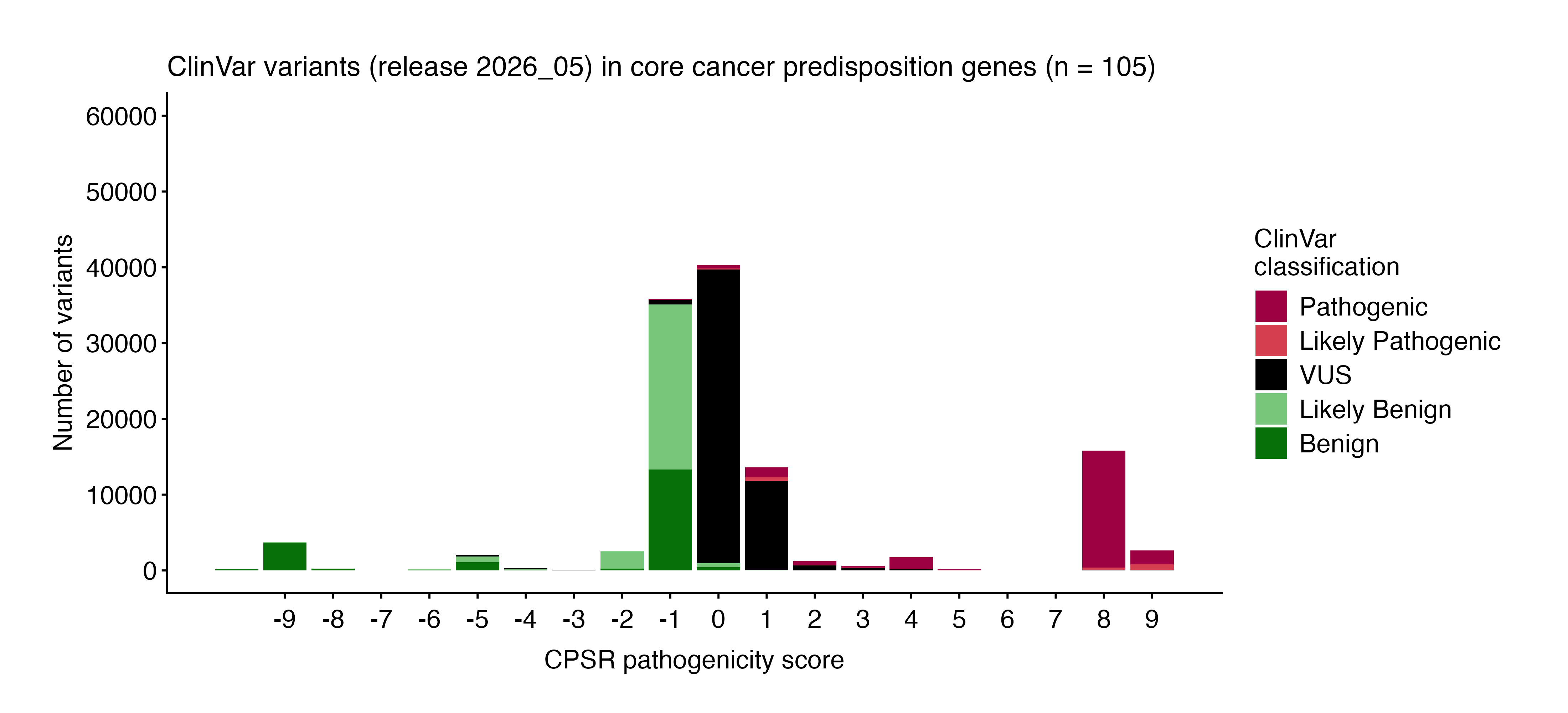
The following thresholds are currently used to assign classifications based on pathogenicity scores:
| CPSR_CLASSIFICATION | CPSR_PATHOGENICITY_SCORE |
|---|---|
| Pathogenic | [4, ] |
| Likely Pathogenic | [2, 3] |
| VUS | [0, 1] |
| Likely Benign | [-3, -1] |
| Benign | [, -4] |
Although the final CPSR pathogenicity score per variant is derived from a summation of matching evidence scores/weights, certain weights are downgraded in particular contexts. Specifically, the weight provided by supportive computational predictions (e.g. PP3, BP4) will not count towards the final pathogenicity score if no other weight is provided by other criteria. Also, if a variant has only a single (non-strong, i.e. moderate/supporting) pathogenic evidence criterion matching, yet reaching CPSR’s likely pathogenic score threshold, it will be downgraded to a VUS in order to avoid overclassification based on limited evidence (in line with ACMG/AMP guidelines).
Note that the score thresholds above may be subject to change in future CPSR releases, as we continue to refine and optimize our classification algorithm based on emerging evidence and user feedback.